
The Washington Post’s Eli Saslow, winner of the 2014 Pulitzer Prize for Explanatory Reporting, has collected a series of oral histories from the COVID-19 pandemic. In today’s installment from his “Voices from the Pandemic,” we meet Lori Wagoner, a 63-year-old clerk at the general store in the small coastal town of Oriental, NC.
Lori’s story really struck me this morning. I hope you’ll take a few minutes to read it.
I often feel like we’re living through some kind of post-modern war without bombs or military hardware, where the pain from a raging conflict comes because we are turning on one another, strangers and family alike. Rather than relying on science, we have insidious conspiracy theories and selfish declarations of “personal freedom” and “mask acne” that are the cause of senseless suffering and death. And while there may not be literal explosives dropping from the skies, the weapons seem like they are nearly as lethal, at least on our psyches.
Lori is not alone. She is one of hundreds of thousands (if not millions) of Americans who are essentially stranded on the front lines, engaging in sometimes physically violent combat against her callous and narrow-minded fellow citizens because she doesn’t have a choice.
What on Earth do we do about this?
_________________________________________________________
From the Voices from the Pandemic oral-history series
The Washington Post, July 19, 2020, Page A-1
As told to Eli Saslow
JULY 18, 2020
‘No mask, no entry. Is that clear enough? That seems pretty clear, right?’
Lori Wagoner, retail clerk, on trying to enforce a state requirement to wear masks
We tried our best to be polite about it. I’d frame it to customers like they were doing us this big favor: “Would you please consider wearing a mask?” “May we offer you a free mask?” “We sure do appreciate your cooperation.”
I’ll never understand what’s so hard about putting on a mask for a few minutes. It’s common sense. It’s a requirement now in North Carolina. But this is a conservative place, and there are only 900 people in this town. We try hard to get along. We’re a small general store, and we didn’t want to end up in one of those viral videos with people spitting or screaming about their civil rights. We put a sign outside — an appeal to kindness. “If you wear a mask, it shows how much you care about us.”
We found out how much they cared. It became clear real quick.
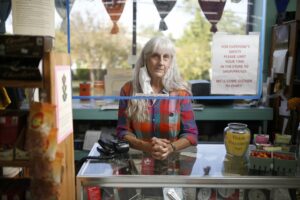
Wagoner put a shield over her register to protect herself from the virus. (Eamon Queeney for The Washington Post)
I’m 63. I’m a lifetime asthmatic. I’d watch customers pull into the parking lot without their faces covered, and my whole body would start to tense up. Our store is on the Intracoastal Waterway, and people from all over the world dock in the harbor and come in here for supplies. It’s a big petri dish. I put a shield up over my register, and a few hours into my shift it was covered with spittle. We’d have 20 or 30 people walk by the sign and come in without a mask. I’d try to get their attention and point to the sign. It was a lot of: “You’re infringing on my rights. This is a free country, and I’m here to shop, so who’s going to stop me?”
Then the local sheriff went on Facebook and said he wasn’t going to enforce the state requirement because he didn’t want to be the “mask police.” So now what? I have customers who are breaking the law and putting my life at risk, and what am I supposed to do? I’m a freaking retail clerk. I ring up beer and boat supplies for 10 bucks an hour. I don’t want to deal with this. If I didn’t need the money, I’d be home working in my garden or visiting my grandkids. I don’t come into the store every morning looking to make some big moral stand, but when I see something that’s wrong, I can’t let it slide. I cannot shut up. I get stuck on things. That’s my biggest downfall or my biggest asset. So, fine. I’ll be your mask police. What choice do I have? I talked to my co-worker, and we decided to hang another sign on the wall.
“Thanks for wearing a mask. It’s the most patriotic thing you can do.”
That didn’t stop them, so we kept adding more. “Please be kind to us.” “We’re here for you seven days a week, and we didn’t create this situation.” “Masks are required for anyone entering the store.”
Wagoner put a shield over her register to protect herself from the virus. (Eamon Queeney for The Washington Post)
Maybe some people took it as a challenge. I don’t know. But it kept on escalating. Most of our customers are supportive and respectful about it — maybe 90, 95 percent. But on weekends, we get dozens of people from Charlotte or Raleigh who come to visit their boats. Those places are virus hot spots, and they come here to have a good time and maybe they’re drinking. Some of them would see our signs, open the front door, and just yell: “F— masks. F— you.” Or they would walk in, refuse to wear a mask and then dump their merchandise all over the counter. I had a guy come in with no mask and a pistol on his hip and stare me down. I had a guy who took his T-shirt off and put it over his mouth so I could see his whole stomach. “There. A mask. Are you happy?” I had a lady who tried to tape a pamphlet on the front window about the ADA mask exemption, which is a totally fake thing. It’s a conspiracy theory, but it’s become popular here. She kept saying we were discriminating against people with disabilities. What? Why? How? None of what they say sounds logical. I can’t make sense of half the names they call me. They say I’m uneducated — uh, that’s kind of ironic. They say I’m a sheep. I’ve been brainwashed. I’m pushing government propaganda. I’m suffocating them. I’m a part of the deep state. I’m an agent for the World Health Organization. “How do you like your muzzle?” “Is this going to become sharia law?” “Are you prepping us to wear burqas?” “What’s next? Mind control?”
The customer’s always right. We grit our teeth and try to accommodate the customer. We offer them free masks, even though they cost about a dollar. If the mask makes them uncomfortable for whatever reason, we say they can wait outside and we will be happy to provide curbside service at no extra charge. If that somehow offends them, we apologize and suggest they shop somewhere else. Then it’s: “My rights, my rights. Why are you trampling on the Constitution?”
My fists are clenched all the time now. I’m always on edge. I wish this virus were glitter so we could actually see it, because in my mind, it’s everywhere. I wear gloves to touch the merchandise. I wipe down everything. I put a table in front of my register so nobody can come closer than six feet. I sanitize my hands so much they must be drunk. We had three new positive cases on the same day in this town, but people can’t be bothered to put a piece of cloth over their face. The sheriff’s department is closed to the public because it has a bunch of positive cases, but they still won’t enforce the mask law. One day I said to my co-worker, “I need to leave the store right now or I’m going to lose it. I’m going to explode.” I ended up taking 12 days off. I had a dream that I was going around the store and physically moving people six feet apart, scolding them for not wearing a mask. I came back to work and decided I wasn’t going to take it anymore. I handed out these laminated cards that say: “Mask Exemption Override – There is no ADA exemption for mask wearing.” If a person refuses to wear a mask, I’m like: “Okay. Goodbye. Have a nice life, and thoughts and prayers if you get covid.” They’re selfish. They’re lemmings. I don’t know if the virus will kill me or if it’s going to be my rage. Sometimes I want to cut America into different pieces, and all these anti-maskers can live together, and we’ll see how it works.
A few weeks back, we put an orange traffic cone on the sidewalk out front to draw people’s attention before they come into the store. We taped up another sign. “No mask, no entry.” Is that clear enough? That seems pretty clear, right? But this big, burly guy walked past the cone and past all the signs, and he pushed the door open. I said, “Sir, can I help you?” I pointed to the signs. I pointed to my mask. He was probably in his late 30s, and I’d never seen him before. He rolled his eyes and ignored me, so I knew where it was going. I came out from behind the register to try to block his path into the store. I said: “Do you have a mask you can put on?” He shook his head like he couldn’t be bothered, and he said he just wanted to buy a drink. I said, “Okay, that means I will get your drink while you wait outside and I will bring it to the door.” But he’s still moving into the store, and I’m trying to stay in front of his path and keep him from going down the aisle. He said, “Come on, lady. I just want water. I have an ADA exemption.” I said: “I’m tired of this. Just leave the store now.”
He kept moving toward me, yelling, “ADA exemption, ADA exemption,” and now my body was starting to shake. It was fear and so much anger. Why is this my problem to deal with? This maskhole? This covidiot whose stupidity is putting me at risk? This isn’t what I signed up for. I’m trying to be the enforcer. I’m trying to corral this guy to the door, but he’s not backing down, and he’s getting more aggressive. He’s screaming about his rights. He’s yelling at me to call the police. We’re six inches apart. He yells out: “Social distancing! Move out of my way.” He’s screaming all kinds of profanity, and I’m screaming it back. My co-worker was yelling for him to get out, and another customer started yelling, and finally he stomped around for a while and then turned back outside.
We locked the front door and my co-worker and I went back into the storage room. We sat there and sobbed.
The next morning, I went to the hardware store to buy supplies. I can’t handle the constant tension. It’s rinse and repeat with all these daily blowups, and I’m starting to get paranoid. We installed a doorbell so we can keep the front door locked even during business hours, and I’ve got pepper spray up at my register. This is my job now. At least I’ll be ready.
 The
The 